
Intelligent translation with AI: preserve meaning, context and natural expression
A sentence can be grammatically translated and still sound wrong. IndieTranslate is designed to interpret the full message, produce a target-language version and refine that result so people receive a clearer expression of what the speaker or writer intended.

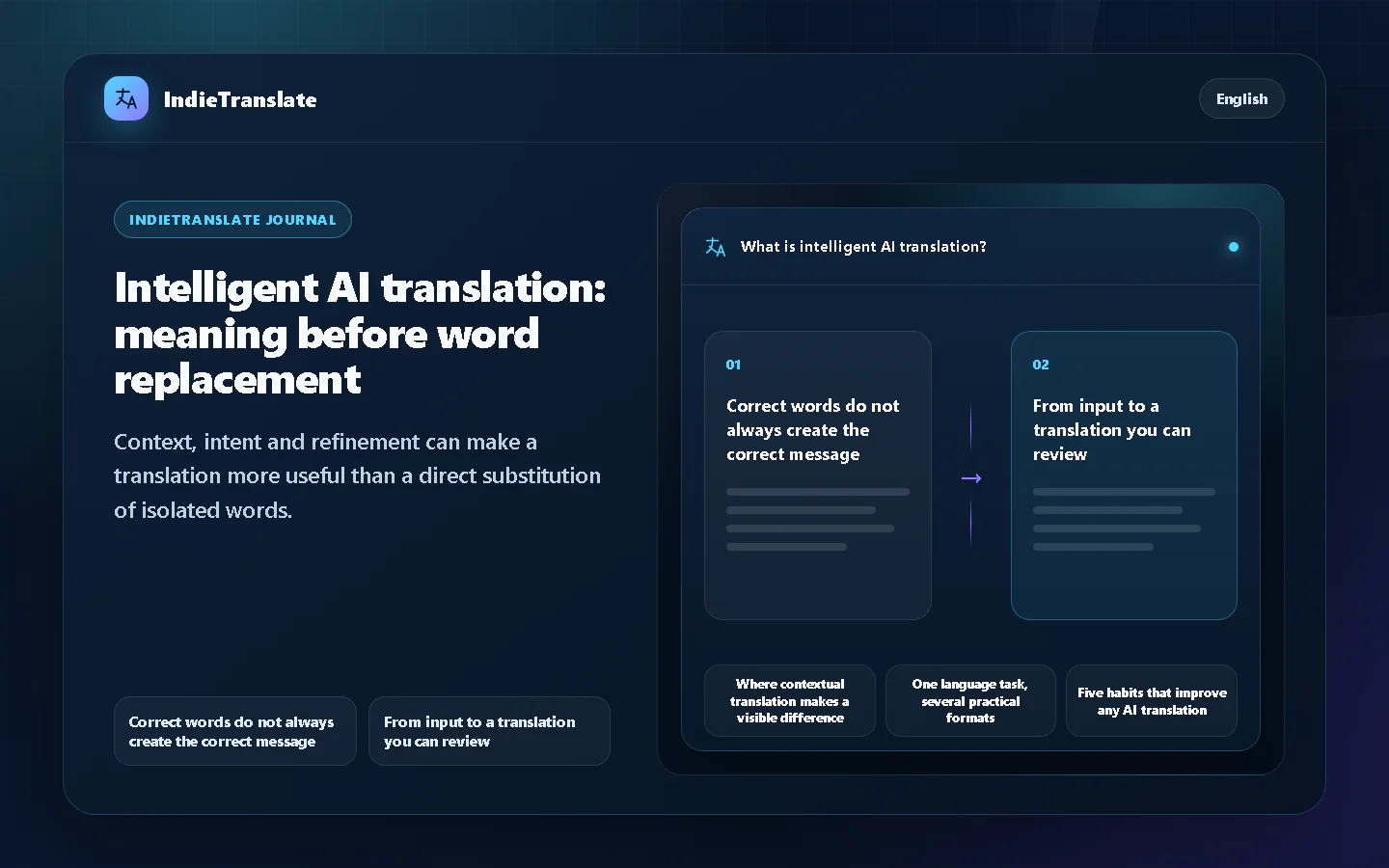
What is intelligent AI translation?
It is a translation process that considers the message as a whole—including context, purpose and natural expression—instead of treating each word as an independent replacement. The result still requires human review when names, numbers or high-impact decisions are involved.
Correct words do not always create the correct message
Idioms, indirect requests, professional terminology and cultural habits rarely map perfectly between languages. “That may be difficult” can be a polite refusal in one context and a solvable obstacle in another. A word-by-word system may keep the vocabulary while losing the speaker’s actual position.
Intelligent translation looks for relationships across the sentence and, where the conversation provides them, across the surrounding context. It then selects an expression that sounds plausible in the destination language while preserving the main intent.
From input to a translation you can review
In IndieTranslate, a user can start with text, spoken input or supported imported content. The system identifies the source message, translates it for the chosen destination language and presents the written result. Depending on the selected feature and supported language, that result may also be available as audio.
The visible text is important: it gives the user a moment to check proper names, figures and the intended tone before sharing. Intelligent automation should make review easier, not hide the result behind a black box.
- Choose the source and destination languages.
- Provide a complete phrase with the necessary context.
- Read the translated text and correct critical details.
- Use audio when available and appropriate for the conversation.
- Keep a human in the loop for consequential communication.
Where contextual translation makes a visible difference
Travel problems, customer support, negotiations, housing, education and collaboration all contain implied information. A guest saying that a room is “a little cold” may be making a polite request for help. A client asking whether there is “room in the budget” is opening a negotiation, not describing physical space.
In these situations, a natural result reduces the work the listener must do to reconstruct the intention. It also helps the original speaker sound more like themselves: courteous, direct, reassuring or professional according to the situation.
One language task, several practical formats
Some moments call for typing: a noisy station, a street address or a price that must be exact. Other moments are easier by voice. An existing recording may arrive as a voice message. A flexible translation platform should let the user choose the format that fits the situation without losing the central objective of clear meaning.
Personalized voice features, when available and used with consent, can make spoken output feel closer to the speaker’s identity. They do not change the underlying need to verify content, and no one should clone another person’s voice without explicit authorization.
Always check names, amounts, dates, addresses and binding terms before sending a translated message.
Five habits that improve any AI translation
AI performs better when it receives a complete, unambiguous message. Replace vague pronouns with the relevant subject, explain uncommon acronyms and include the detail that determines the meaning. If you need a formal answer, write the original in a clear professional tone.
After translation, read for purpose rather than matching every word. Ask whether the destination reader will understand the request, reason and next step. If the answer is uncertain, rephrase the source or add context instead of repeatedly translating the same ambiguous sentence.
- Write complete thoughts rather than isolated fragments.
- Name the situation, product or person when ambiguity is possible.
- Avoid slang unless it is essential to the message.
- Review facts that cannot be inferred from context.
- Use professional review for legal, medical and official material.
Intelligent does not mean infallible
AI translation can make mistakes, especially with poor audio, rare terminology and incomplete context. Its strength is helping people communicate more effectively in ordinary situations; its limit is that it cannot assume responsibility for a decision.
IndieTranslate is most valuable when the user combines its speed with careful judgment. The technology proposes a bridge between languages, and the person decides whether that bridge is clear enough for the moment.
Frequently asked questions
Is intelligent translation the same as literal translation?
No. Literal translation follows words and structure closely; intelligent translation aims to preserve the intended meaning and use natural expression in the target language.
Can I translate both text and voice?
IndieTranslate supports multiple input and output workflows. Exact options depend on the selected feature, account access and supported languages.
Will the result always be perfect?
No automatic system is infallible. Review important content and use qualified professionals for high-risk or legally significant communication.
What information should I verify?
Always verify names, numbers, dates, addresses, prices, dosage, contractual terms and any fact whose error could cause harm or loss.
Translate the idea—not only the sentence
Try IndieTranslate with a complete real-world message and see how context can produce a clearer, more natural result.